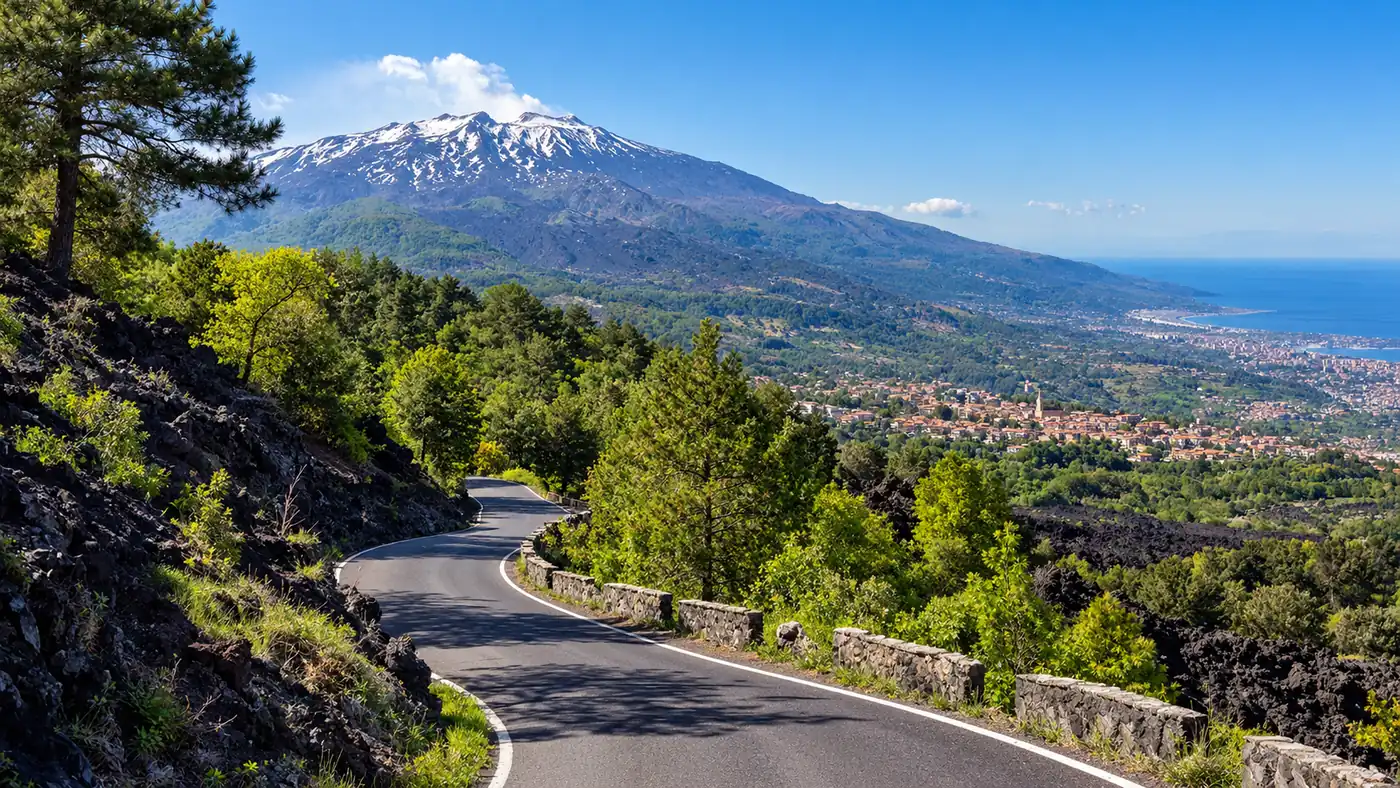
Booking choice: The Bocca Nuova summit trek, ★ 4.8 (2,257). Check dates Compare the options below
Walking on an active volcano sounds risky, and it is fair to ask. The honest answer is that Etna is managed: scientists measure it constantly, the civil protection decides who may go where, and the guides follow those decisions to the letter.
This guide explains how the monitoring and closures work, what Etna did in 2024 to 2026, when you can see lava and what the real risks are on a normal hike. For the effort itself, see how hard the Etna hike is. For where you may walk on your own, see hiking Etna without a guide.
The quick answer
Is it safe: yes, within the rules and with an authorised guide above about 2,500 m on the south side. Monitoring: INGV Osservatorio Etneo, day and night, with a weekly bulletin. Closures: the regional civil protection can close the summit zone at short notice, guided hikes included, as it did on 13 August 2026. 2026: lava fountains at the Voragine in late July and August, lava in the Valle del Bove, ash from the Northeast Crater from 24 September. Lava: sometimes visible, never guaranteed; stay at least 300 m from any lava front. On the hike: thin air, cold wind at 3,000 m, gas near the craters, loose sand on the descent. Not for people with heart or breathing problems on the high routes. Flights: ash can close Catania airport for a day; check your flight status.
Is it safe to hike up Etna in 2026?
Yes, if you stay within the rules: marked trails on your own below the summit zone, and an authorised guide above it. The summit zone closes when the volcano is restless, and on those days no one goes up, guided groups included.
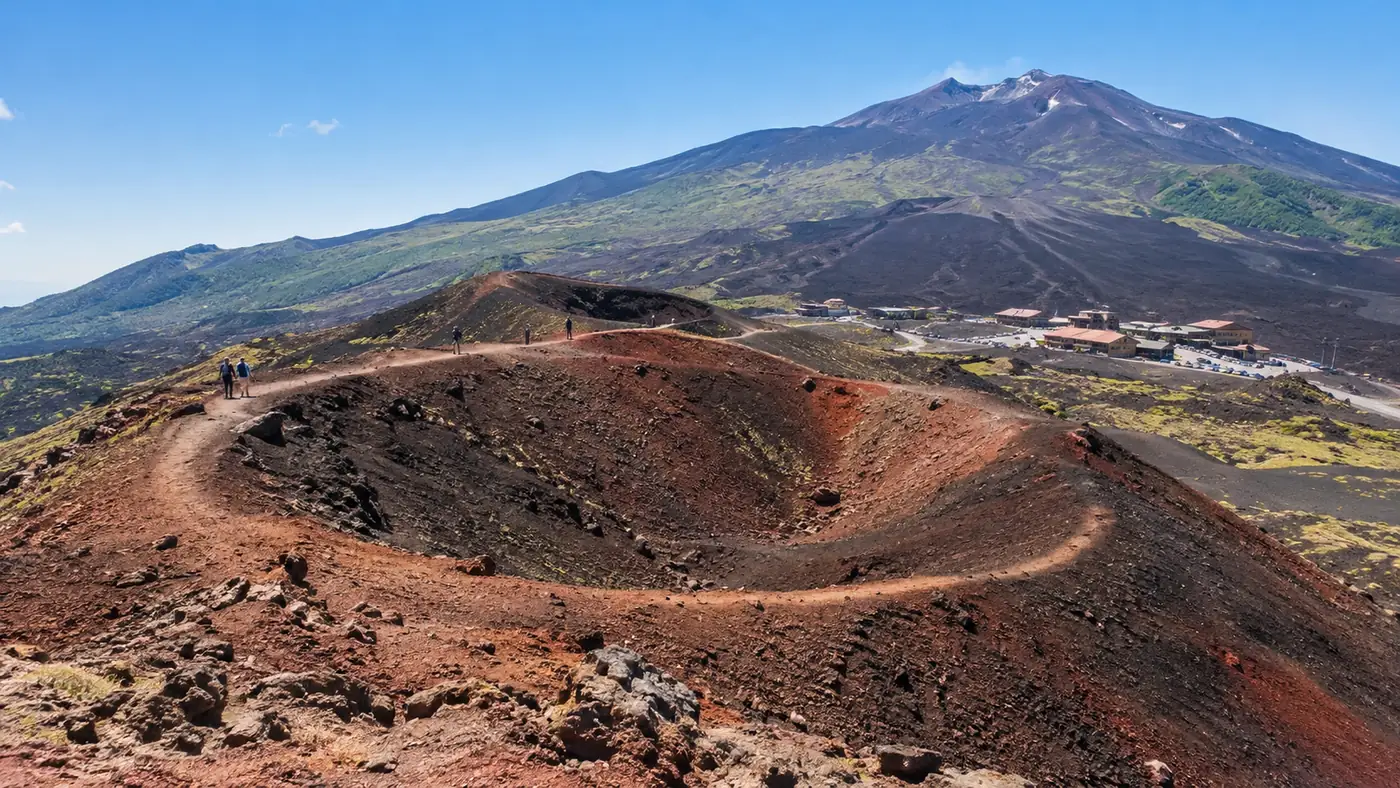
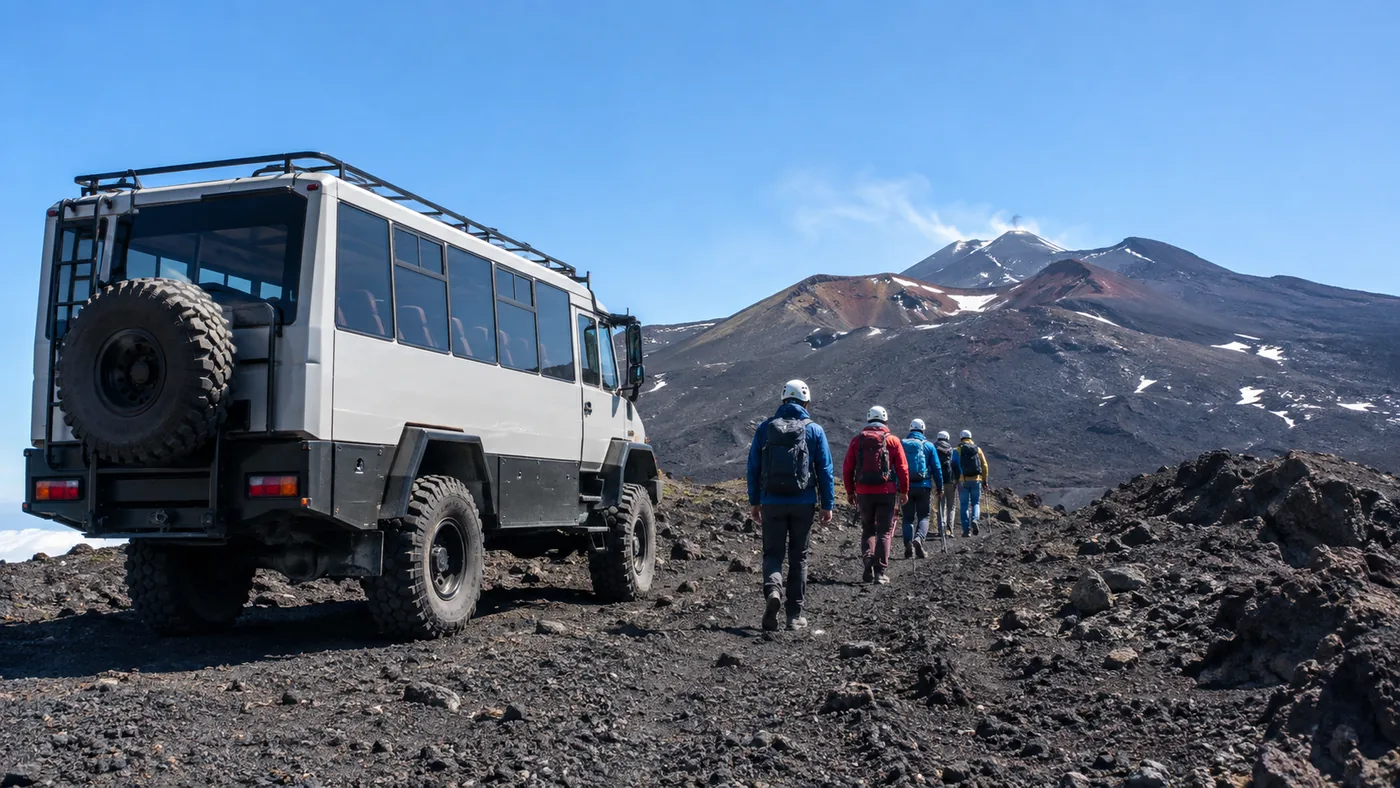
INGV, the national institute that watches Etna, says plainly that the volcano can produce phenomena without warning and that the hazard is never zero. That is why access is layered. The Silvestri craters and the nature trails near the refuges are open to everyone and visited every day. In the summit zone, only authorised Alpine or volcanological guides may lead groups, with a maximum of 10 people per guide, everyone in a helmet, and groups spaced apart.
The guides check the alert level and the weather before every departure, and they change the plan without hesitation: a lower route, the other side of the mountain, or no summit at all. If you book a summit hike, accept that the volcano decides the route on the day.
Who decides when Etna's summit closes?
The regional civil protection, based on INGV's monitoring and its automatic alert system for lava fountains. The mayors of the towns on each side then issue ordinances, and the guides must follow them.
The INGV Osservatorio Etneo in Catania follows the volcano with seismometers, cameras, gas sensors, ground deformation and satellites, and publishes a weekly bulletin on its website. Since 1 April 2022 an automatic system called ETNAS has estimated the probability of lava fountains. When it rises, the regional civil protection, Protezione Civile Sicilia, can raise the alert phase, and every summit excursion stops.
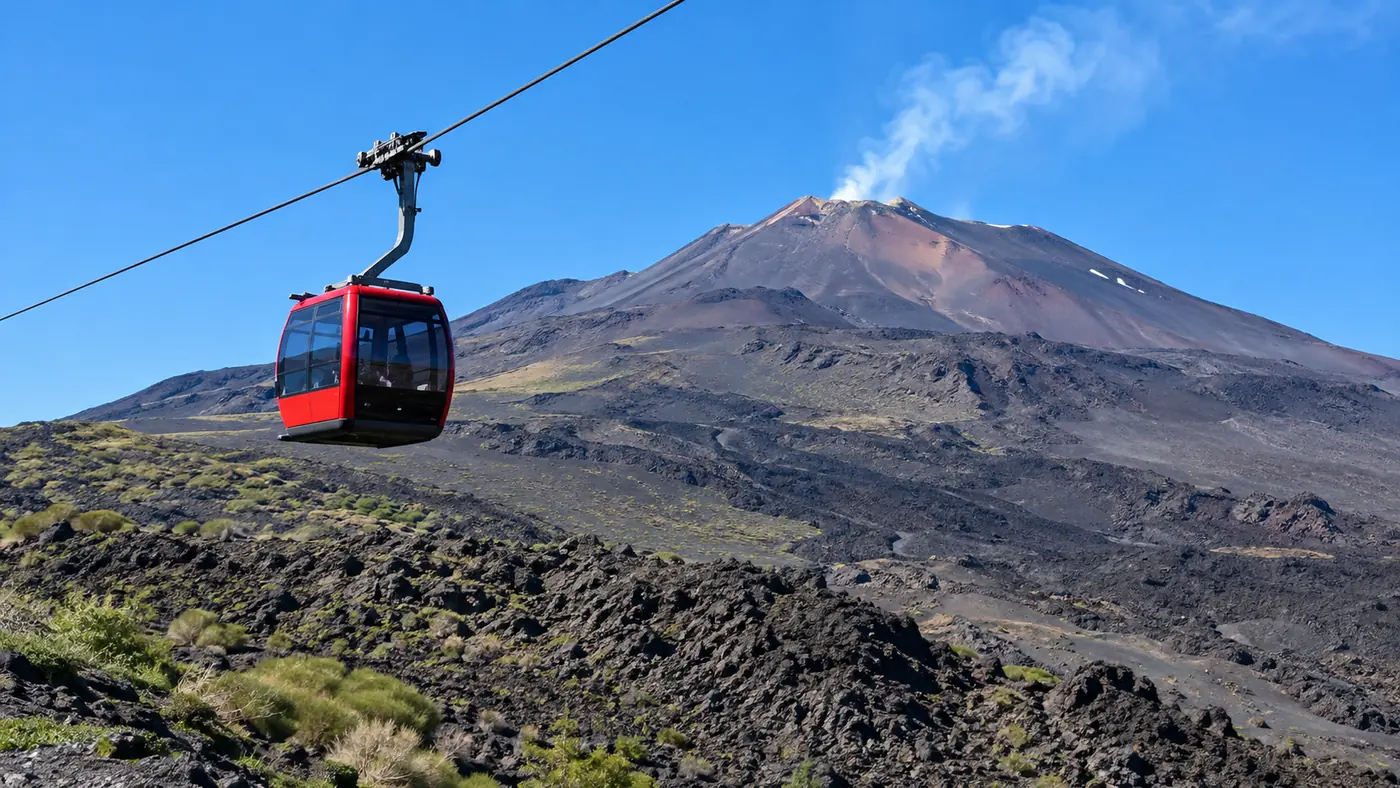
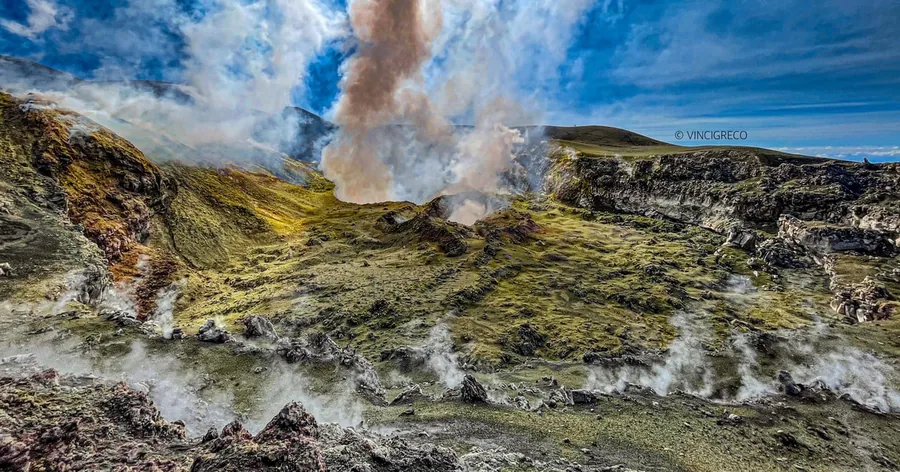
That is what happened on 13 August 2026: the whole summit zone was closed, the access tracks on the south and north sides were manned, and all high-altitude excursions were suspended. Ignoring a closure can get you reported to the judicial authorities. On days like that, guides turn round at 3,000 m or lower, or move to the other side. The Bocca Nuova crater trek, for example, takes the cable car only, up to the highest permitted altitude, when the summit is not possible.
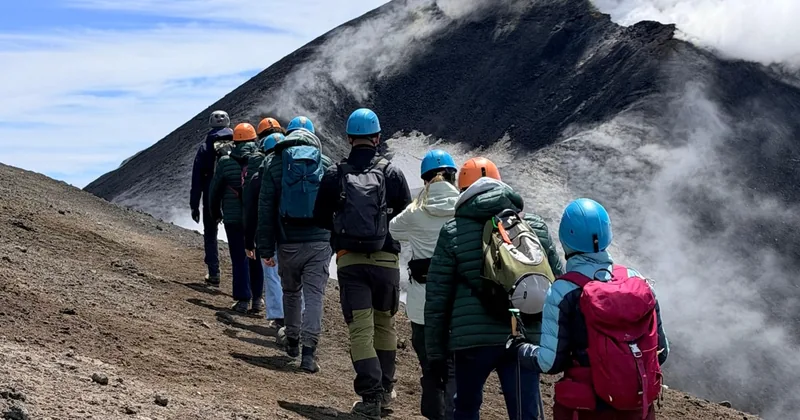
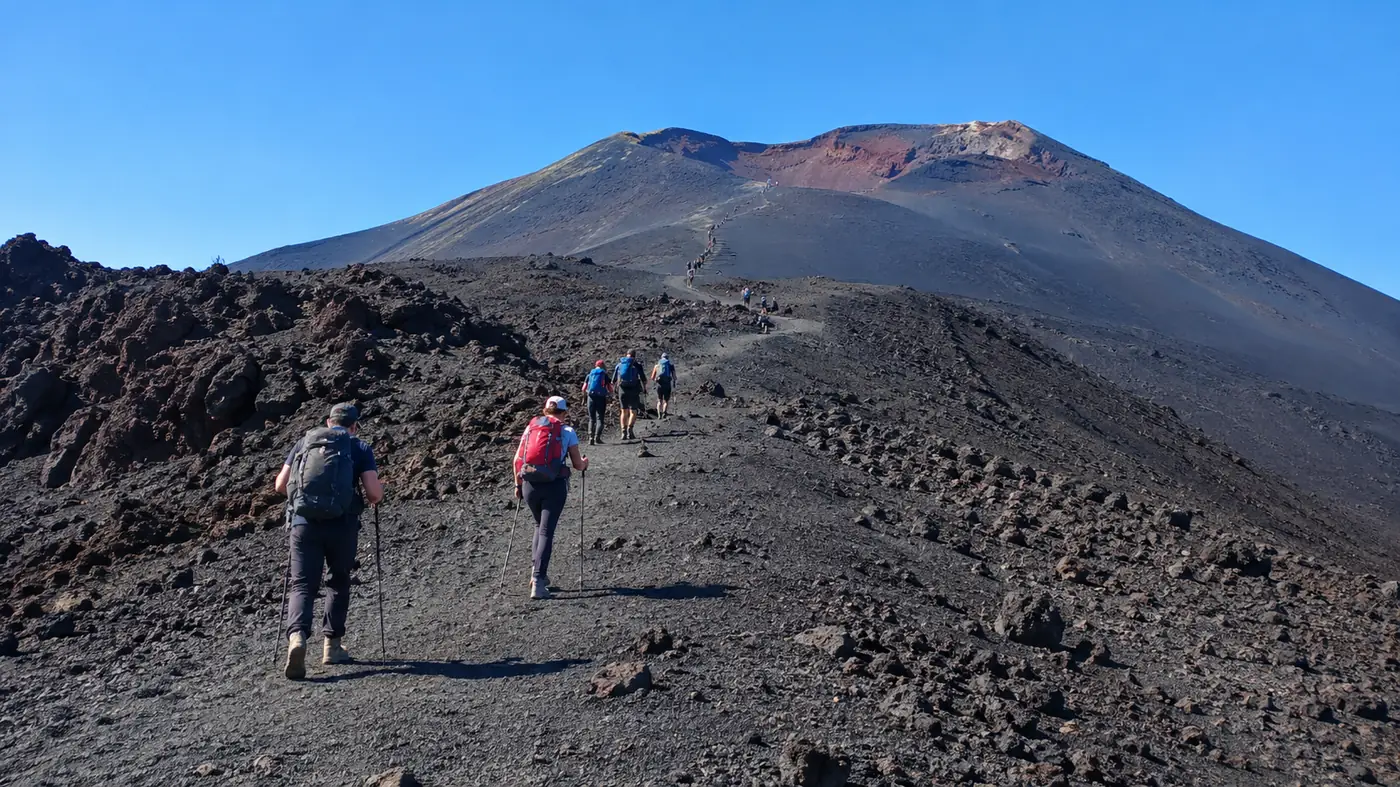
A summit day led by a volcanologist who checks the alert level first: cable car and 4x4 to about 2,850 m, then on foot to the Bocca Nuova rim when allowed, with helmet and insurance. Reviewers say they felt very safe. Rated 4.8 from 2,257 reviews.
Explore the Bocca Nuova summit trekWill Etna erupt again in 2026?
It already has, several times. Etna erupted in summer 2026 and was still emitting ash at the end of September, so more activity this year would be normal for it. Nobody can forecast the dates.
Summer 2026 was busy. At the end of June an effusive fissure opened at about 3,000 m at the base of the Northeast Crater. In late July and August the Voragine produced lava fountains, and lava flowed into the Valle del Bove, the great valley on the east flank, well away from the villages. On 13 August the summit zone was closed. From 24 September the Northeast Crater began emitting ash, with a cloud of about 4 km and light ashfall on the south-east flank down to the coast.
INGV's bulletin of 29 September 2026 expects frequent explosive activity at the summit and possible lava in the summit area. In practice, this means the high routes may open on some days and close on others. September 2026 reviews show that summit treks did run on some days, sometimes switched to the north side.
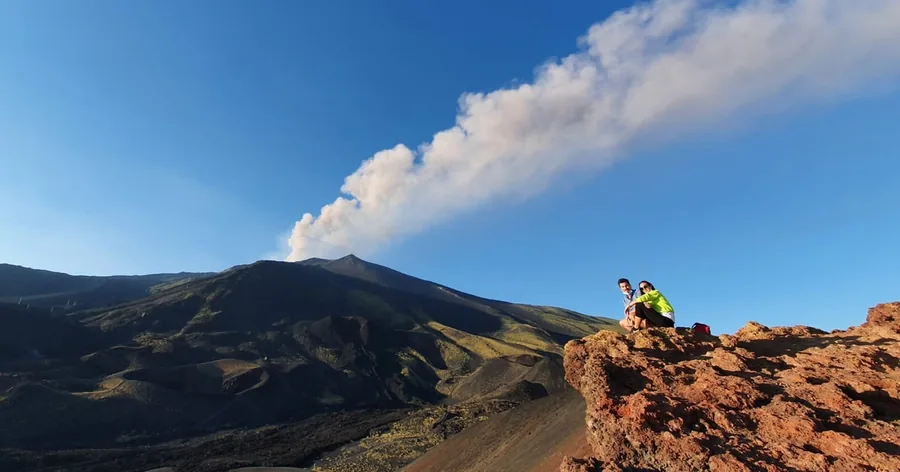
How many times has Etna erupted recently, and what does it look like right now?
Etna has had eruptive episodes every year from 2024 to 2026. At the end of September 2026 it was emitting ash from the Northeast Crater, while the Voragine and the Southeast Crater were only steaming. For today's picture, check the INGV bulletin and the guides.
Over the last 40 years, INGV counts a flank eruption about every 2 years on average, and summit activity, from degassing to lava fountains, is far more frequent. In July and August 2024 the Voragine's paroxysms raised its rim to 3,403 m, the highest point ever measured on Etna. In February 2025 lava flowed from about 3,000 m down the west flank. In 2026 there were episodes in June and July, the lava fountains of July and August, and the ash of late September.
- INGV: the weekly bulletin and any special notices on the Osservatorio Etneo website.
- Civil protection: the alert phase and closures on Protezione Civile Sicilia.
- The cable car: whether it is running, on the Funivia dell'Etna site.
- Your guide: the tour's messages the evening before and on the morning of the hike.
A volcanological guide, a helmet and insurance, and a route set on the day: the 3,000 m craters, or the summit area when the alert level allows.
Check dates for the guided summit hikeWhen can you see lava on Etna?
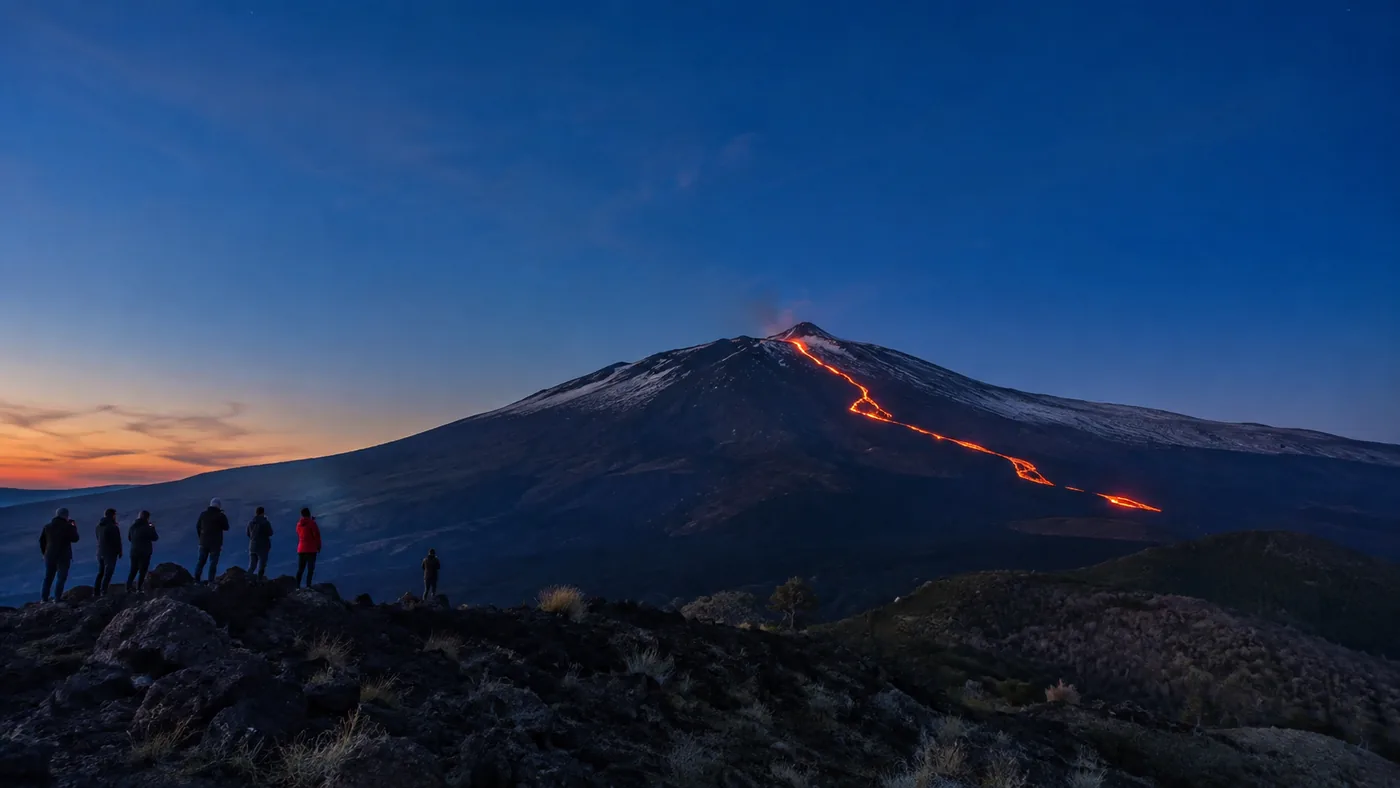
Only during eruptive phases, and never on a fixed schedule. When lava is flowing, it shows best at dusk from viewpoints and on sunset tours. No tour can guarantee it.
In August 2026 the flows in the Valle del Bove were clearly visible at sunset, and tour operators took groups to watch them from a distance. The eastern villages, such as Milo, Sant'Alfio and Fornazzo on the Mareneve road, look straight into the Valle del Bove and are good viewpoints when lava runs there. On any slope, the rules keep you at least 300 m from a lava front, because lava meeting snow can cause explosions.
If you book a sunset tour, book it for the walk and the light. The Etna Sunset Walk, Lava Cave and Tasting (4.8 from 1,786 reviews) and the Etna Sunset Guided Tour from Catania (5.0 from 771 reviews) both walk easy terrain near 2,000 m with pickup in Catania. If the summit glows that evening, it is a bonus.
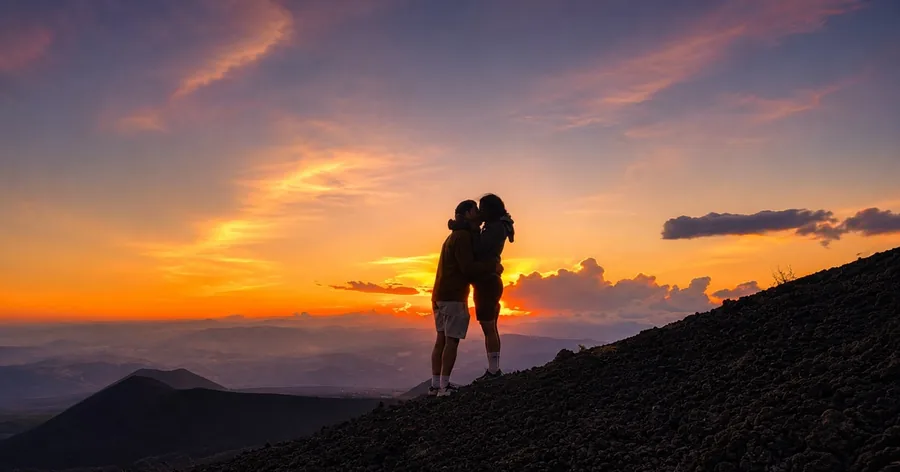
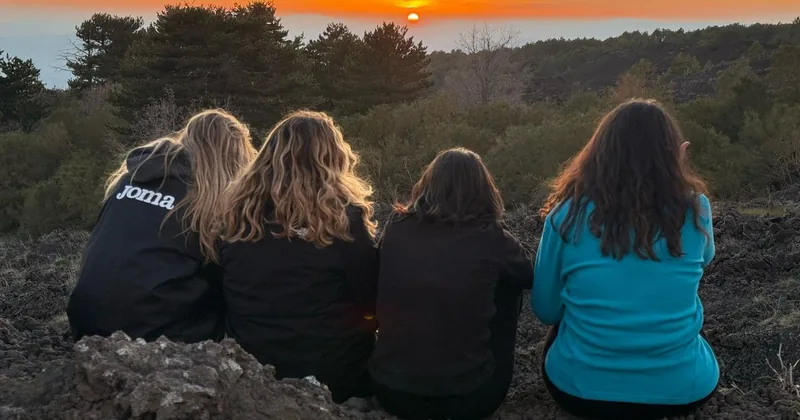
An easy evening on the volcano: a farm tasting, the Grotta dei Tre Livelli lava cave with helmet and headlamp, and a sunset walk on old craters near 2,000 m, with pickup in Catania. Rated 4.8 from 1,786 reviews.
Explore the sunset walk and lava caveHow many people have died in Etna's eruptions?
Very few, given how active Etna is. The great eruption of 1669 has no documented deaths. The two serious modern accidents were explosions at the summit craters: 9 people died in 1979 and 2 in 1987.
In 1669 lava reached Catania and destroyed villages and part of the city, but no deaths are documented; the figure of 20,000 dead often repeated online is a myth, probably confused with the earthquake of 11 January 1693. On 12 September 1979 a sudden explosion at the Bocca Nuova killed 9 people, and on 17 April 1987 an explosion at the Southeast Crater killed 2. Both happened at the summit craters, which is exactly why access there is now limited to authorised guides, small groups, helmets and open days only.
Some searches mix Etna up with other volcanoes. Campi Flegrei, the "supervolcano" in the news, is a caldera near Naples about 400 km away and has nothing to do with Etna. The deadliest eruption on record was Tambora in Indonesia in 1815. And Taftan in Iran, said to be "waking up after 700,000 years", showed ground uplift, not an eruption.
What are the real risks on an Etna hike?
On a normal day the risks are those of any high mountain: thin air, cold wind, sudden weather and a steep, loose descent, plus volcanic gas near the craters. Good boots, warm layers and following the guide deal with most of them.
At about 3,000 m the average temperature is around 6 degrees, near 12 degrees in midsummer, and strong gusts are common. Clouds often build over the summit after midday. The high routes are not for people with heart or breathing problems; the operators and the ordinances say so. The Summit Craters Trek asks for moderately trained hikers, and reviewers say you should be reasonably fit. How the effort feels is covered in how hard the Etna hike is.
| Risk | What it means on a hike | What you do |
|---|---|---|
| Altitude | Thin air above 2,500 m; you tire faster | Walk slowly, drink, skip the summit with heart or breathing problems |
| Cold and wind | About 6 degrees on average at 3,000 m, strong gusts | Windproof jacket, hat, gloves, long trousers, even in August |
| Volcanic gas | Sulphur dioxide and carbon dioxide near craters and vents | Stay upwind, follow the guide, step back if it stings |
| Loose sand and ash | Steep descents in deep volcanic sand | Ankle boots, poles, short steps |
| Sudden weather | Cloud, fog or wind can arrive within an hour | Start early, carry a layer, turn back with the guide |
| Volcanic activity | The summit zone can close at short notice | Check INGV and your guide; never pass a closure |
| Lava fronts | Explosions where lava meets snow | Stay at least 300 m away |
Is it safe to go to Sicily right now?
Yes. Sicily is welcoming visitors as usual. The main practical effect of Etna's activity is occasional flight disruption at Catania airport, so check your flight status before you travel.
Ash from the eruptions can close or limit Catania airport. In September 2026 landings were reduced on 24 and 25 September, and the airport closed for the day on 27 September, with flights diverted to Palermo, Comiso and Trapani. Catania, Taormina, Syracuse and the beaches carried on as normal. The airport operator's advice is simple: check your flight status before you leave for the airport.
Leave a little slack in your plans: book the Etna hike for a day after you land, not the day itself, and keep a spare day if you can. If the operator cancels for weather or the volcano, it refunds or offers another date, and every tour on this site gives a full refund if you cancel up to 24 hours ahead. Routes from the airport to the volcano are in getting to Etna from Catania.
Frequently asked questions
What happens if the summit closes on the day of my hike?
The guide changes the route: a lower walk, usually up to 3,000 m or below, or the other side of the volcano. Some tours then take the cable car only, up to the highest permitted altitude. If the hike cannot run, the operator refunds or offers another date.
Is volcanic gas dangerous on Etna?
Near the summit craters and vents the gas can sting your eyes and throat. Guides keep groups upwind and move on; on the lower trails it is not a concern for walkers.
Are the lower trails safe for children?
Yes. The Silvestri craters and the easy crater walks near 2,000 m are visited by families every day. Keep to the marked paths and bring a warm layer.
Where can I check Etna's activity before I go?
The INGV Osservatorio Etneo weekly bulletin, Protezione Civile Sicilia for closures, Funivia dell'Etna for the cable car, and your guide's messages the evening before.
Ready to book
Choose your hike
Check your date and the live price on GetYourGuide; the refund terms are shown on each option.
Summit Crater Trek to the Bocca Nuova
Cable car and 4x4 to 2,850 m, then up to the Bocca Nuova rim near 3,300 m with a volcanologist; lift ticket extra
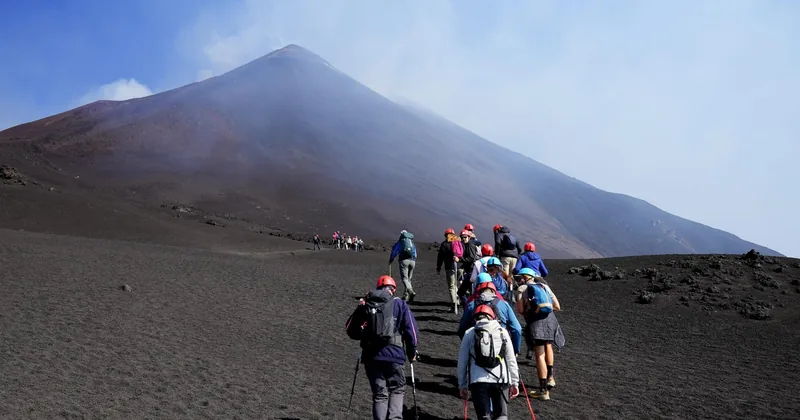
Etna Guided Summit Hike up to 3,400 m
- A certified volcanological guide
- Choose the 3,000 m trek or the summit trek
- Helmet, insurance and hiking gear if available
Etna Sunset Walk, Lava Cave and Tasting
An easy evening walk on old craters near 2,000 m, a lava cave with helmets and a farm tasting; no summit